ipf_pre_press_release_product_selector_high_performance_light_barriers_en.docx
185 KB
More transparency with solutions from ipf
High-performance light barriers from ipf electronic have a number of special features and therefore offer interesting potential for a wide range of applications. For example, the systems enable the testing of products in hybrid design and thus part-in-part recognition even with absolutely opaque housing.
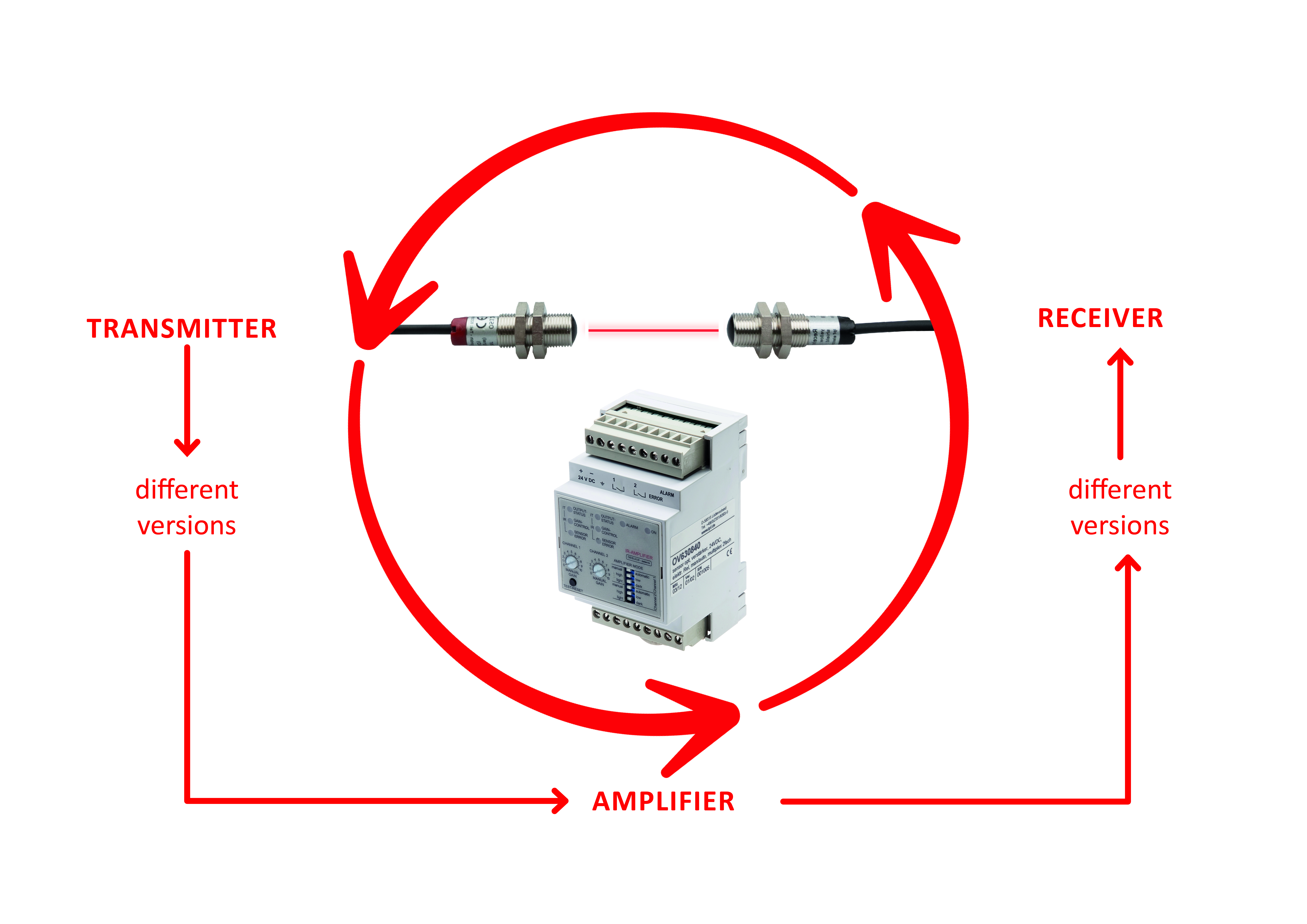
High-performance light barriers consist of a selection of transmitters, receivers and amplifiers with various basic functions, including a measuring operational mode, a manual power regulator and automatic power control. The light barriers work with non-visible, extremely short-wave infrared light, which has excellent penetration properties. Due to the high transmitting power, the systems can achieve ranges of up to 70 meters. The available power reserves are generally used for contamination compensation, but are also suitable for part-in-part recognition in non-metallic housing.
For this purpose, ipf electronic recommends systems with a single-channel amplifier such as the OV620800 with switching output. The amplifier can be set via a DIP switch so that two options are always available for the inquiry: A switching output is set when there is additional damping of the light barrier (component to be tested is in the housing) or when the damping is removed (component is missing). The sensitivity required for the application is set via a potentiometer on the amplifier.
This type of system in manual operational mode can be used to implement a wide variety of solutions for very different tasks, such as checking the presence of a printed circuit board installed in a closed plastic housing, to name just one example.
However, the amplifier with switching output can not only monitor a single, previously specified limit value, but also several different limit values via the teach function. This means that several different products can be monitored with one system, e.g. if the size or material thickness of the test specimens changes or if the housing materials change.
Single-channel amplifiers such as the OV62C903 with additional analog output enable the measuring operational mode and thus even more precise inquiries, as they proportionally map the received signal of the high-power photoelectric sensor. Such solutions can, for example, check an opaque housing for the presence of several stacked component inserts inside, whereby the 0-10V signal can also be used to determine the exact number of inserts. An example of this would be the inspection of individual dividers, which are located as baffles in a container. The only restriction here too: Neither the housing nor the inserts to be tested may be made of metal or have a complete metallic coating. Exceptions are self-contained housings made of a metal mesh.
Further links