ipf_pre_press_release_inductive_ring_sensors_en.docx
170 KB
Multifunctional inductive ring sensors from IPF
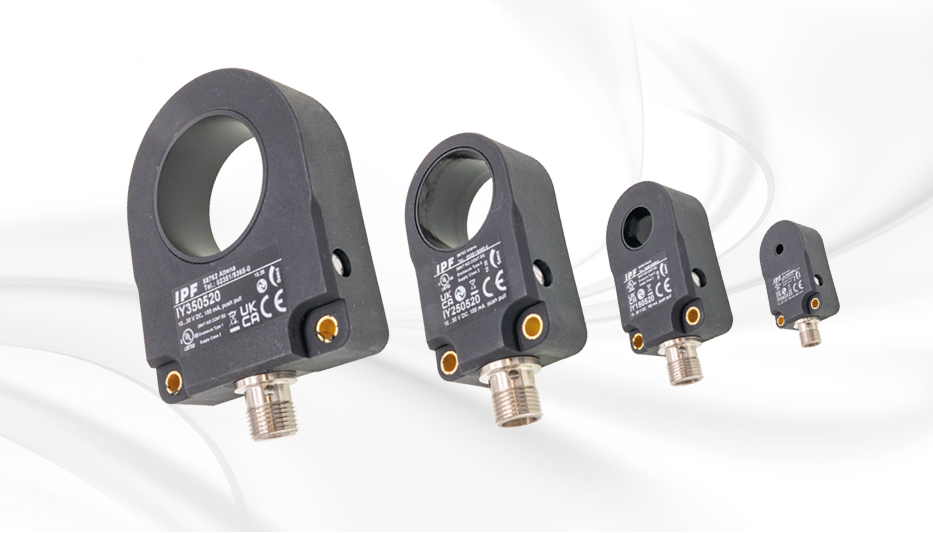
If you want to reliably recognize metal objects in industry, even under extremely harsh operating conditions, the best solution is to use the wide range of inductive sensors from IPF. But what to do if a small, metallic component ejected from a machine does not hit the detection range of the sensor? The answer is provided by the new multifunctional inductive ring sensors from IPF.
The active area of these sensors is located within a ring-shaped opening. If a metal part falls through, the alternating magnetic field of the active surface is damped and a switching signal is triggered. For example, metallic objects can be guided through a plastic tube that is fed through the opening of the sensor in order to reliably detect the objects.
When detecting metallic parts with inductive ring sensors, a distinction is generally made between static and dynamic modes of operation. Static: The switching output remains active as long as an object is in the active zone (ideal e.g. for filling level or congestion monitoring or presence monitoring). Dynamic: A metal part must move, whereby the switching output is set for a certain time when an object is detected until the active zone is free again (ideal e.g. for counting parts). Until now, however, separate devices were required for each of these two operational modes.
This has now changed with the new family of inductive ring sensors from IPF. With just one device version, teach-in can be used to select not only the sensitivity, but also the desired operational mode (static or dynamic) of the probes and between a normally closed (nc) and normally open (NO) function for their switching output.
Furthermore, the integrated IO-Link interface enables a whole range of additional, helpful settings, e.g. the choice between different device modes (standard, precision, speed), turn-off delay of the switching output, hysteresis setting between 0 and 20%, single value, two-value or window function for the switching output, additional virtual switching output when operating in an IO-Link-capable control unit, single-point, two-point or dynamic teaching for each switching output, etc. For example, the additional options available via IO-Link can be used to determine the falling speed of objects in the detection range of the sensor or to set the detection of metal parts of a specific size or size range, to name just a few practical examples.
Apart from the housing color (black instead of the previous blue), the new devices are identical in construction to the previous inductive ring sensors from IPF. As the sensitivity can also be adjusted as usual via a potentiometer, there is nothing to prevent previously installed IPF sensors from being replaced without any problems.
The new series is available with ring diameters between 6mm and 50mm. New is the IY300520which, with a ring diameter of 30mm, bridges the gap between the IY250520 (Ø 25mm) and the IY350520 (Ø 35mm). The sensors with a ring diameter of 100mm from the previous series remain in static (IYK00320) and dynamic (IYK00325) versions remain part of the IPF range.