ipf_pre_Pressemitteilung_Lasertaster_PTQ80470_PTQ80475.docx
135 KB
New diffuse reflection laser sensors from IPF
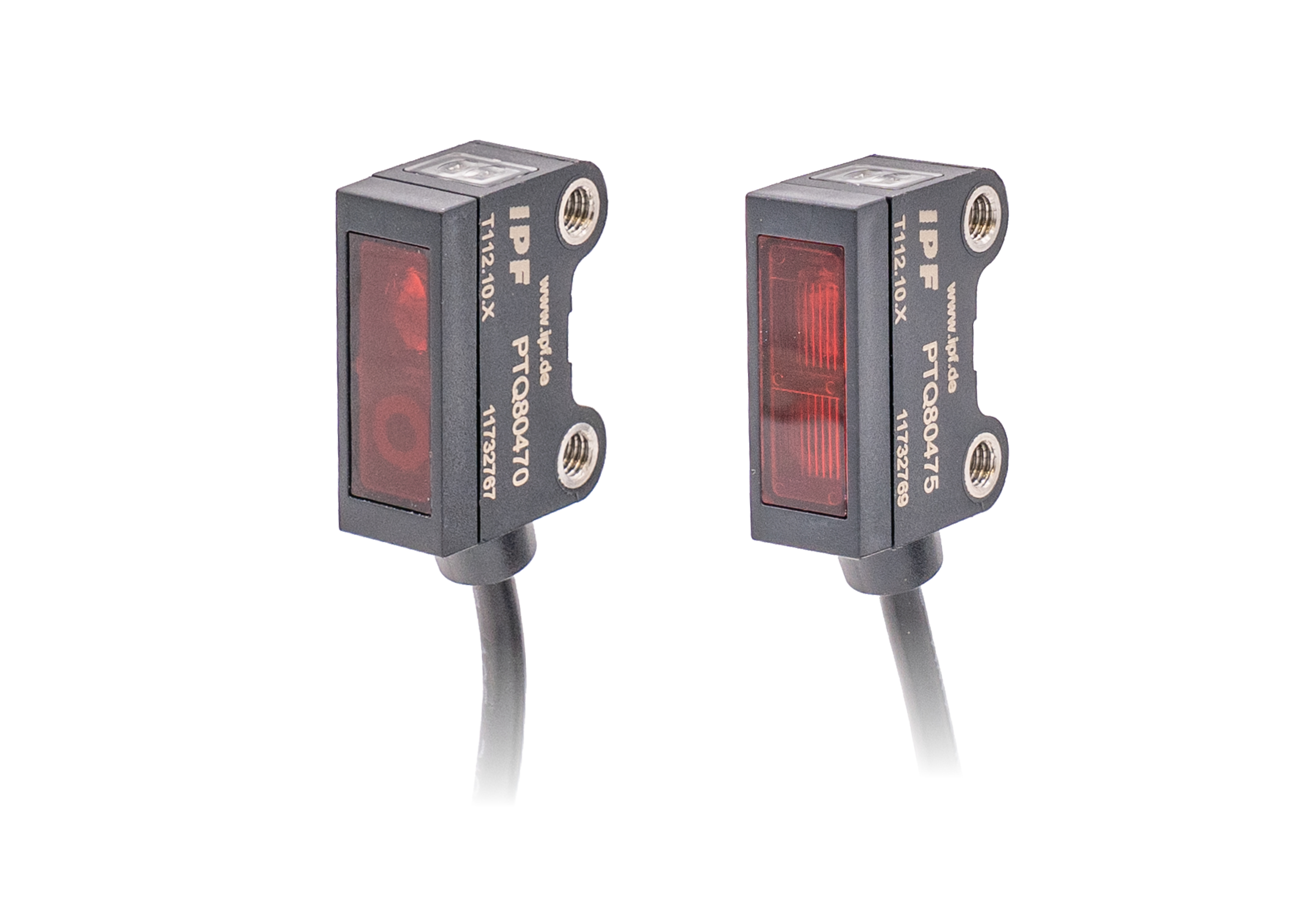
The exceptionally compact load sensors with background suppression from the OTQ8 series from IPF, with ranges between 20 and 200 mm, are characterized, among other things, by their small light spot (7 mm or 16 mm) and their very narrow laser line (42 mm, height 57 mm) at the end of the measuring range (maximum sensing range). However, there are always applications that require even greater accuracy. And this is exactly where the new diffuse reflection laser sensors PTQ80470 and PTQ80475 come into play.
Like the OTQ8 series, based on the principle of background suppression via triangulation. As a result, these diffuse reflection sensors are suitable for highly accurate detection of objects, virtually independent of the surface’s reflectivity, while reliably suppressing any potentially interfering backgrounds.
The PTQ80470 emits a point-shaped light beam (visible red light, laser class 1). At the focal point, with an object distance of 40 mm, the diameter of the light spot is just 0.25 mm; at the maximum adjustable sensing range of 120 mm, it is only 4 mm. Thanks to a short response time of 0.5 ms, not only can very small objects be detected, but they can also be detected at high speeds.
The PTQ80475 features an extremely fine laser line that also emits visible red light (laser class 1). Its focal point is at a sensing range of 60 mm, at which point the line is 28 mm long and 0.5 mm wide. At the maximum adjustable sensing range of 120 mm, the line is 60 mm long and 2 mm wide. This sensor is ideal for objects whose exact position within the detection area is unknown. The objects need only be within the line’s detection range and reflect sufficient light at the appropriate angle. E.g., when detecting round objects such as wire or objects with an uneven surface, the objects need to reflect sufficient light at the appropriate angle. The PTQ80475 (response time 2 ms) can demonstrate all its advantages.
The sensing distance for both devices is set via the proven, simple teach procedure, in which the rear panel of the device is touched with a ferromagnetic tool; this also protects the sensor from unintended tampering. The electrical connection is made via a 4-pin M8 cable connector in each case.
Regarding the mechanical installation of the PTQ80470 and the PTQ80475 , there is also a special feature: the sturdy metal inserts in the mounting holes have an M3 thread. Together with the optionally available brackets (e.g., AO000580) or the universal mounting AY000116 , this greatly simplifies installation.