ipf_pre_pressrelease_PT64_en.docx
329 KB
ipf electronic presents new laser triangulation scanners
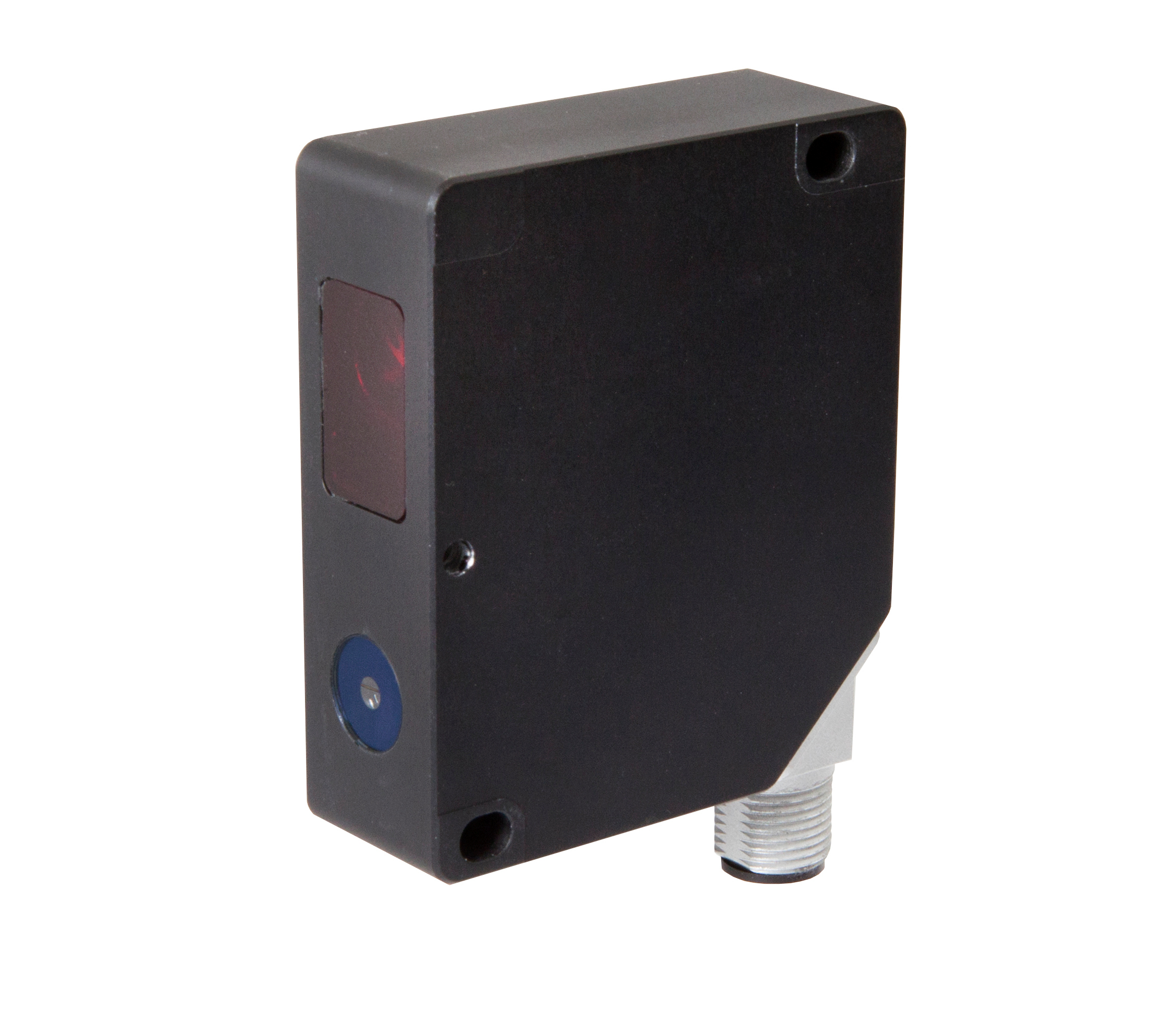
At the Hannover Messe, ipf electronic is presenting the PT64 a new series of laser triangulation scanners (laser class 2), which have a number of features in terms of both device design and high application flexibility.
When it comes to the almost color-independent detection of objects during distance measurement or positioning, the PT64 offer an extremely economical solution. The compact devices in robust metal housing (IP67) integrate a teach button to determine the measuring range start and end point, two LED status displays, two digital inputs, two analog outputs (0-10V to 4-20mA) and two additional digital outputs. A particularly striking design feature is the 180° rotatable connector plug of the PT64which allows the diffuse reflection sensor to be installed in almost any position.
The new products from ipf electronic already provide a large number of basic device functions for easy start-up on delivery. All PT64 provide a distance signal ex works in relation to the entire measuring range of the respective device type, with the smallest measuring range being 21mm to 45mm and the largest ranging from 150mm to 1,000mm. Depending on the device type and thus the measuring range, the diffuse reflection sensors also achieve resolutions of 6µm to 250µm.
Two versions with laser spot or laser line
With all PT64 the user can choose between two versions, one with a laser spot and one with a laser line, which differ only in terms of the transmission optics.
The PT64 with point-shaped laser beam design enable extremely precise, pinpoint measurements and are therefore suitable e.g. for distance measurement and positioning of very small objects or for very precise measurements at specific positions of components with complex geometries. If, on the other hand, rough or inhomogeneous object surfaces need to be inquired into, the PT64which generate a laser line. If a linear laser beam hits such surfaces, a large proportion of the surface is captured by the beam, which improves the reflection of the light towards the sensor and thus the reception signal of the diffuse reflection sensor. The device versions with a laser line are therefore particularly suitable for measurements on milled or roughened metal parts, cast parts or metal wire layers on coil bodies, for example.
More possibilities with free software
In addition to the laser triangulation probes, ipf electronic offers free software that significantly expands the potential range of applications for the new products in practice.
Among other things, the software can be used to visualize the reflection signal of a surface impinging on the receiving element of a diffuse reflection sensor and thus determine the signal quality of a PT64 during distance measurement or positioning.
If you want to determine more precisely what is happening during measurement value acquisition and evaluation, the two digital inputs of the diffuse reflection sensor can be configured in a very application-oriented way with a range of functions already stored in the software.
The two analog and digital outputs of the diffuse reflection sensor can also be configured for specific measurement tasks using the software. Examples of the switching outputs include monitoring a limit value or switching point for overshooting or undershooting or a limit range check, such as checking a component height within a previously defined tolerance band.
Via the analog outputs, the software can be used to store specific final values for the measuring range limits in the diffuse reflection sensor. One of the PT64's features in this context is the so-called drag pointer function, in which the analog outputs output the highest and lowest measured distance value via a measuring cycle. By determining the difference between the two extreme values, the user receives, for example, a limit value that is to be monitored.
Last but not least, the free software allows function-related parameters of a PT64 and save them to a PC or external data carrier. All relevant parameters are therefore always repeatable and available at any time.
If a diffuse reflection sensor needs to be replaced, these parameters can then simply be transferred to the device again via software, eliminating the need for time-consuming re-parameterization.
The PT64 replace the previous diffuse reflection laser sensors of the PT65 and PT66 from ipf electronic. However, the new series provides users with three devices in a single robust industrial solution: an analog sensor, a switching sensor and a contrast scanner.
Further links
sensor laser, diffuse-reflection PT64