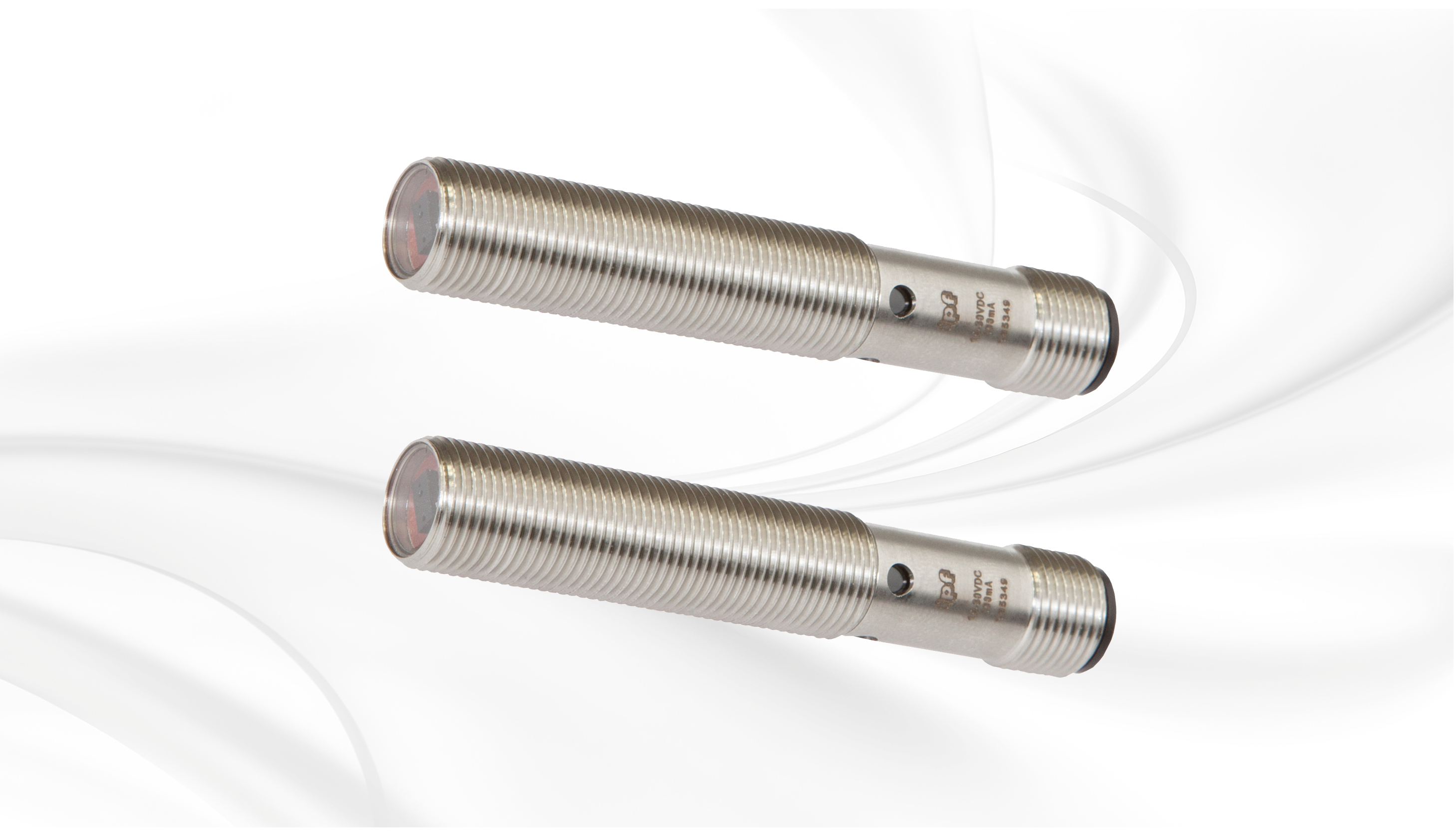
New laser sensor is now even more versatile
The space-saving PT120320, which works on the principle of time-of-flight measurement, has been available since mid-2016 and has now proven itself as a reliable problem solver in hundreds of applications.
We are pleased that the sensor has been well received. Nevertheless, it was time to revise the device to make it a little bit better. The result is the PT120520 laser sensor with two major innovations. Thanks to a new sensor chip, the range has been increased 8-fold to 1200mm at a similarly low power. There is also an optional IO-Link interface, which offers many new setting options and provides valuable diagnostic data.
As usual, the PT120520 can be taught in via a teach-in input. However, the IO-Link interface offers a whole range of new practical benefits. If the switching distance of 1200 mm is not sufficient for an application, the range can be increased to 4000 mm via IO-Link by selecting the "Long" mode in the settings. For fine-tuning, the detection range can be limited in width, which actively hides edge objects. Increasing the sampling time, i.e. the time interval between the individual measurements, leads to a lower switching frequency, but has the decisive advantage of being able to recognize even objects with comparatively poorer reflection properties.
The influence of the settings on the sensor itself can be seen in various parameters, whereby the current switching distance and the switching state of the output are self-explanatory. The ambient rate offers great added value for start-up, but also for any troubleshooting, as it allows conclusions to be drawn about the ambient light acting on the sensor. The so-called spad count shows the number of pulses used for the measurement result. These features are also valuable aids during start-up and troubleshooting.