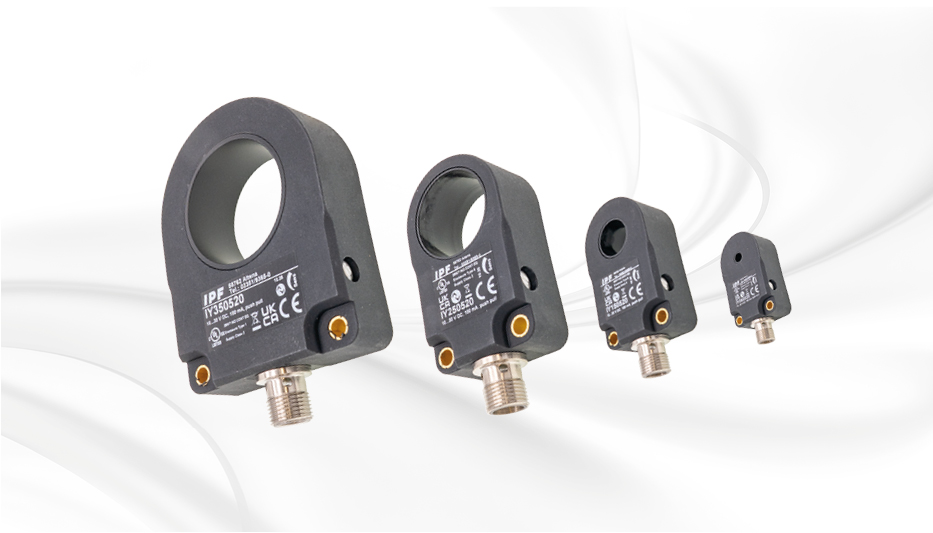
Refreshed and round
Anyone who needs to recognize metal parts in a manufacturing process relies on inductive proximity switches. These sensors work contactless, are resistant to soiling and have proven themselves in many applications.
But what should be done if, for example, a small metal object is ejected from the machine and there is no guarantee that it will move through the sensor's detection range? This is where inductive ring sensors come into play. The detection range is located within a round opening. If a metal part falls through, the alternating magnetic field inside is damped and a switching signal is triggered. If the metal objects are passed through a plastic hose using compressed air, for example, the hose can be guided through the ring sensor to detect the objects. The minimum object size depends on the diameter of the passage opening. Sensors with an opening diameter of 6 to 100 mm are currently available.
When detecting metal parts, a distinction is made between static and dynamic modes of operation. In static mode, the switching output remains active as long as an object is in the detection range (filling level or accumulation control). In the dynamic mode of operation, the metal object must move and the output is set for approx. 100ms when an object is detected. It then becomes inactive again, whereby switching is only possible again after the object has moved on and the active zone has become free.
In order to be able to realize both operational modes for the inductive ring sensors, there were previously two separate devices for each sensor size. The new family of ring sensors from ipf electronic now only requires one device version. Teach-in can be used to select between static and dynamic operation as well as between normally open and normally closed switching output functions. As before, the sensitivity adjustment is made using a potentiometer. Additional settings can also be made using the integrated IO-Link interface of the new ring sensors:
Deactivation of the local operating elements
(potentiometer and teach-in)
Choice between three sensor modes
(Standard, Precision and Speed)
Hysteresis setting between 0 and 20%
Additional virtual switching output for operation in an
IO-Link-capable control (unit)
Single-point, two-point or dynamic teaching for the switching outputs
switching outputs
On and turn-off delay for the switching outputs
(0 ... 60sec in each case)
Single value, two-value or window function for the switching outputs
switching outputs
The window function is an interesting innovation that allows the size of the metal parts to be detected to be set to a specific range. Smaller or larger objects are masked out.
The dimensions of the housing are identical to those of the previous models, so that any replacement with an existing old device is possible without any problems. The new device series is available with aperture diameters between 6 and 50 mm. New is the IY300520which, with a ring diameter of 30mm, bridges the gap between the IY250520 (Ø 25mm) and the IY350520 (Ø 35mm). The devices with a ring diameter of 100mm from the previous series remain in static (IYK00320) and dynamic (IYK00325) versions remain part of the portfolio.