It's all a question of light
In order to reliably solve an inspection task with a camera sensor, the right illumination is immensely important. After all, the camera can only see with the help of light. But not all light is the same, because the arrangement of camera, test object and illumination is the be-all and end-all. In general, a distinction is made between reflected light and transmitted light. With incident light, the illumination is located above an object plane. With transmitted light, on the other hand, the light source is arranged as backlight below an object plane.
When is which illumination recommended? - A brief overview
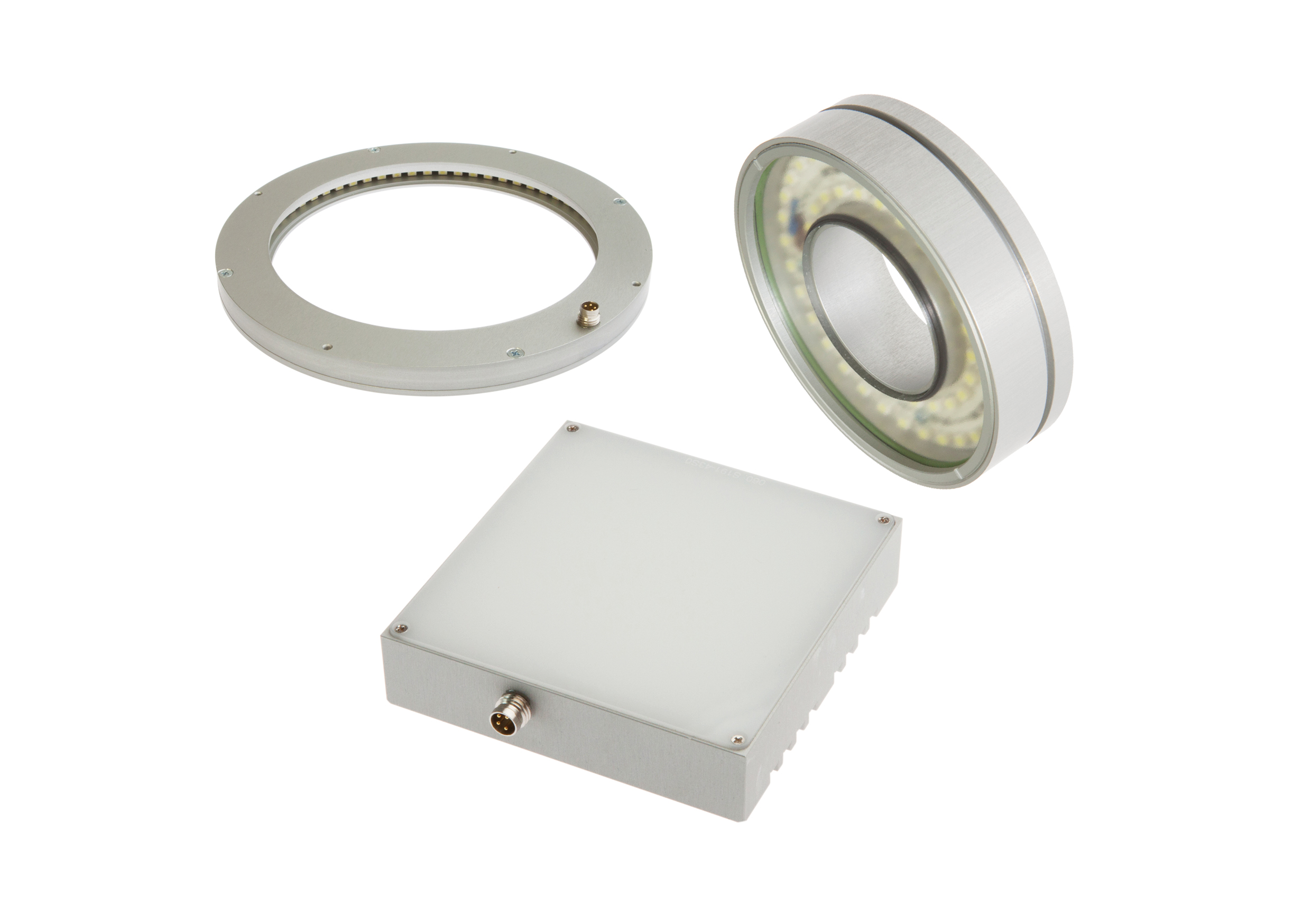
The lighting techniques for incident light are described below: Classic ring lighting is used when inspecting smooth, reflective or shiny surfaces, e.g. when inspecting electronic components on which the completeness of contacts is to be checked, for example. For more complex reflective objects such as foils, crown caps for bottles or data carriers (Blue-Ray, CDs, DVDs), so-called dome illumination is suitable, which enables extremely uniform illumination of a test object. Dark-field lighting is usually positioned at a very short distance from a test object and consists e.g. of flat ring lights, line lights or so-called spotlights. This form of illumination is very often used to detect defects on object surfaces (e.g. scratches or grooves) or to inspect engravings.
With transmitted light illumination, a test object is illuminated from below or from behind in such a way that the rays from the light source are directed towards the camera optics. In this way, a kind of shadow image of the test object is created, in which the object background can be recognized as a bright area in the image display of the camera sensor. This illumination technique is usually used when, for example, the presence of features (such as punched holes or bores) on objects is to be certified, but without placing high dimensional demands on the inspection result.
What is presented here in brief, however, only provides an initial overview via the extremely complex topic of illumination. If you would like more detailed information, we recommend our white paper "Camera sensors Part 3 - It's all a question of light", which is available to download free of charge from the ipf website under the Know How section.