Laser technology for precise measurements
Precise laser sensors from ipf electronic are usually used in many industrial applications, but can also prove their worth in an unusual location, such as an air sports club landing championship.
Pilots have to land their aircraft as accurately as possible on a runway 850 meters long and 45 meters wide. The highest score (200 points) is only awarded if the main landing gear touches down exactly in the 3m short field A. Other fields offer graduated scores up to 5 points in the last section.
Until now, color markings and referees were used to determine the area in which the landing gear of an aircraft touched down. However, possible inaccuracies and residues of the color markings on the aircraft led to the search for alternatives, which ultimately led to the use of laser sensors from ipf electronic.
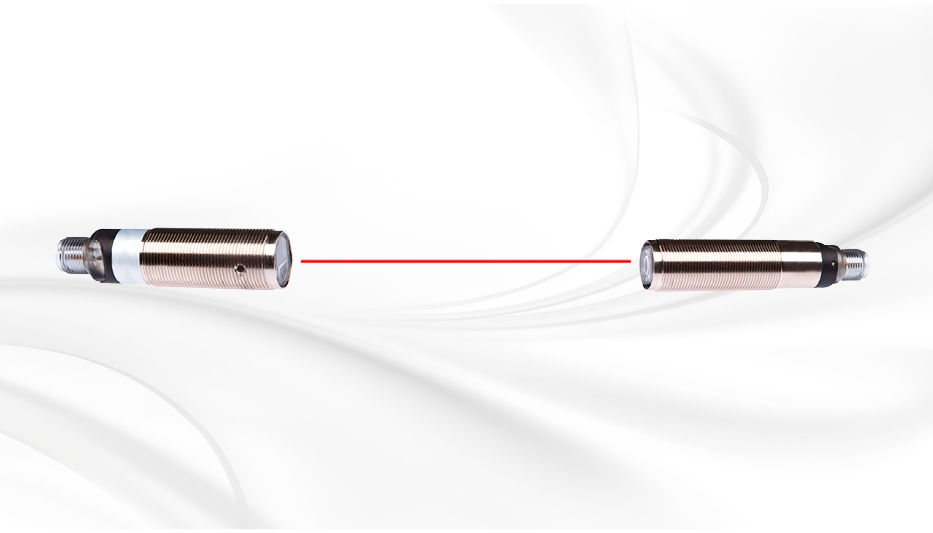
Five laser light barriers - consisting of the transmitter PS180024 and the receiver PE180424 - were installed at the edge of the runway. The through-beam sensors (laser class 1, degree of protection IP67) work with visible red light (wavelength 650nm) and have a range of up to 60m - completely sufficient for the entire width of the runway. Thanks to the wide supply voltage range of 10-30 V DC, the devices could be supplied with power autonomously via car batteries, as laying cables crosswise via the runway was prohibited.
With accessories from ipf electronic such as aluminum tubes, clamps and ball joints, the technology could be installed quickly and safely. The transmitters and receivers of the sensors were precisely aligned with the sensor tester VY000004. A compact housing with a touch panel and a specially written PLC (programmable logic controller) program was used for evaluation. If an aircraft interrupted a light barrier during landing, the clock stored in the program was stopped by the respective switching signal and the corresponding time was recorded for each area. In this way, it was possible to determine exactly when which of the light barriers had emitted a switching signal in connection. The corresponding field on the runway could then be identified from the time sequence.
The new solution was convincing across the board. After all, it provided clear results without any manual observation and its precision significantly increased the fairness of the championship.