New ultrasonic sensors with IO-Link
Users of ultrasonic sensors with IO-Link from ipf electronic now have a free choice of how they want to use the devices, e.g. as diffuse reflection sensors or as reflex barriers. However, the potential of the solutions is far from exhausted. The new ultrasonic sensors detect a wide variety of objects and materials in a contactless manner. Their properties do not play a major role as long as the material reflects the sound. This means that liquids, bulk materials and, of course, solid objects can be recognized, regardless of their shape and color. Ultrasonic sensors are particularly suitable for detecting transparent objects.
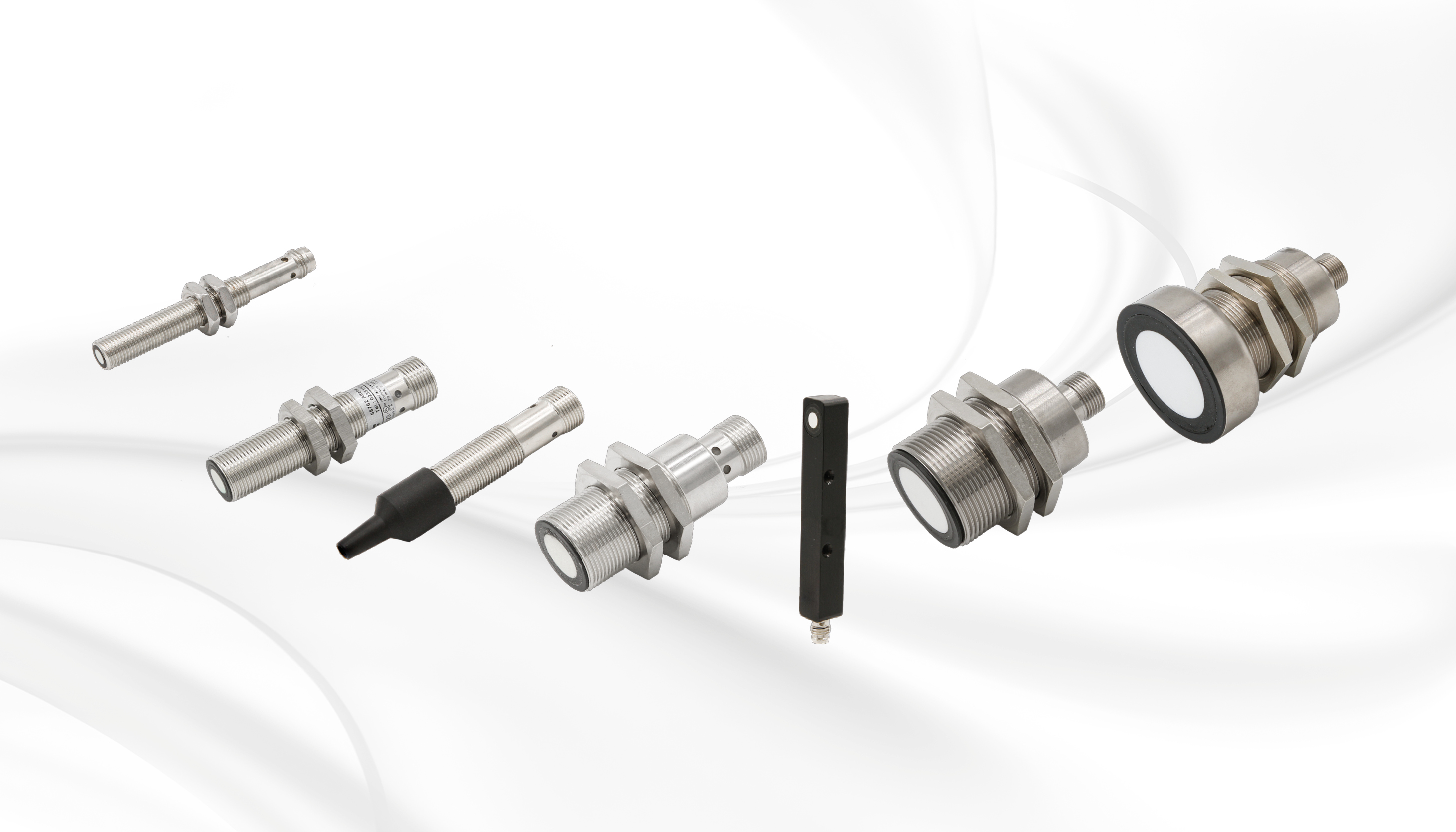
The devices are available in 4 different threaded designs (M8, M12, M18 and M30) and a rectangular design (12x12). All sensors are via an IO-Link interface, which can be used to set several operational modes, the switching or analog ranges and useful additional functions (switch-on and turn-off delay).
The devices with switching output (article-no. UTxx95xx) can basically be set in three ways. In "window mode", an object distance range in which the switching output is active is specified by teaching in two limit values. In "two-point mode", the foreground and background are preset, i.e. "object present" and "object not present", and the sensor automatically sets the switching point in the middle of these two parameters - similar to an optical diffuse reflection sensor with background suppression. The "Autoteach mode" proves to be particularly useful for sensor settings for moving objects, for example. Once activated, the device automatically detects the statuses "Object present" and "Object not present" and also automatically determines the appropriate switching point. Teaching takes place via the white core or PIN 2 of the connection cable.
Thanks to IO-Link, however, other operational modes can also be activated, e.g. two-step control, which is interesting for fill level monitoring, among other things. In addition, the sensors with switching output can be used as reflex barriers, whereby switching point 1 serves as a reference distance and a machine wall or glass surface can be used as a reference surface. Every object between the sensor and the reference surface, regardless of its position or distance from the device, is detected and leads to a signal change at the switching output.
The sensors with analog output (article-no. UTxx90xx) are taught via the black core (PIN 4) of the connection cable. Along with defining the measuring range limits, the analog output can also be switchover from current (4...20mA) to voltage (0...10V). However, the IO-Link interface offers even more setting options, e.g. change-over switchover of the analog output to 0...20mA, allowing even more freedom in selecting the measuring signals suitable for an application. In addition, further functions can be programmed:
I Synchronization:
the sound pulse from up to 10 sensors is transmitted at exactly the same time.
I Multiplex:
Up to 10 sensors are switched on and off again one after the other to rule out mutual interference when several devices are operated next to each other at the same time.
I Switching output:
If this function is active, window, two-point and autoteach modes can also be selected, whereby the switching points are independent of the selected measuring range of the analog output. This means that all the same functions are available as the ultrasonic sensors with switching output.
Another feature of the new generation of ultrasonic sensors with IO-Link:
I The extremely compact UT089570 an ultrasonic sensor in the M8 design
I The UT129521 an M12 sensor with beam columnator, ideally suited for very precise inquiries through the smallest openings (e.g. when checking the fill level in a test tube) and with a switching distance of up to 150 mm
I The UT309523 is a compact device with a switching distance of up to 6m.